Ottila Juliane Kron
Math 3rd Grade Subtraction Worksheet Diagrams and Charts
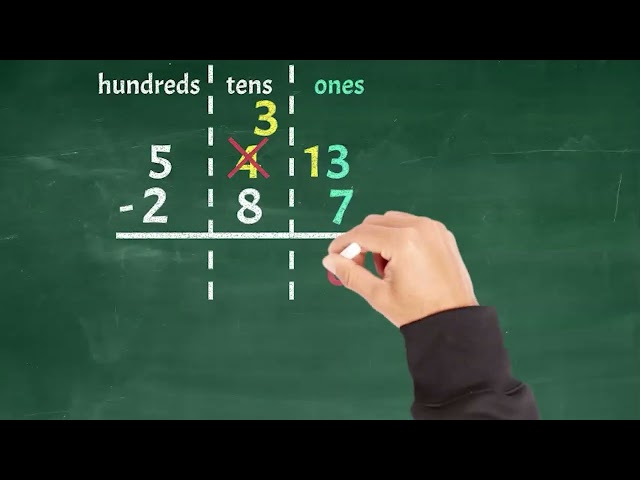
When teaching third graders subtraction, it can be helpful to use diagrams and charts to help them visualize the concepts. These visual aids can make it easier for students to understand how to solve subtraction problems. There are a variety of different diagrams and charts that can be used to teach subtraction, and the best one to use will depend on the individual student’s learning style.
One common type of diagram used to teach subtraction is a number line. A number line is a horizontal line with numbers marked at regular intervals. To solve a subtraction problem using a number line, students start at the larger number and then move to the left along the number line, counting by ones until they reach the smaller number. The number they land on is the difference between the two numbers.
Another common type of diagram used to teach subtraction is a part-part-whole diagram. A part-part-whole diagram is a rectangle that is divided into two parts. The larger part represents the whole, and the smaller part represents one of the parts. To solve a subtraction problem using a part-part-whole diagram, students first identify the whole and the part. Then, they find the difference between the whole and the part. The difference is the other part.
Charts can also be helpful for teaching subtraction. One common type of chart used to teach subtraction is a subtraction table. A subtraction table is a grid with two columns and several rows. The first column contains the minuend (the larger number), the second column contains the subtrahend (the smaller number), and the last column contains the difference. To solve a subtraction problem using a subtraction table, students simply find the row that contains the minuend and the subtrahend, and then read the difference from the last column.
Using diagrams and charts to teach subtraction can be a helpful way to make the concepts more concrete for students. These visual aids can help students to visualize the problems and to understand the steps involved in solving them.
Key Aspects of Math 3rd Grade Subtraction Worksheets
Subtraction worksheets are an essential tool for teaching third graders how to subtract. These worksheets can help students to practice their subtraction skills, and to learn how to solve subtraction problems in a variety of different ways.
- Number lines
- Part-part-whole diagrams
- Subtraction tables
- Real-world problems
- Mental math
- Estimation
- Problem solving
These key aspects are all important for helping students to develop a strong understanding of subtraction. Number lines and part-part-whole diagrams can help students to visualize subtraction problems, while subtraction tables can help them to memorize subtraction facts. Real-world problems can help students to see how subtraction is used in everyday life, while mental math and estimation can help them to develop their problem-solving skills. Finally, problem solving can help students to learn how to apply their subtraction skills to new and challenging situations.
By incorporating these key aspects into their math instruction, teachers can help their students to develop a strong foundation in subtraction.
Number lines
Number lines are a simple but effective tool for teaching third graders how to subtract. They can help students to visualize the subtraction process, and to understand the relationship between the minuend, subtrahend, and difference.
To use a number line to subtract, students start at the larger number (the minuend) and then move to the left along the number line, counting by ones until they reach the smaller number (the subtrahend). The number they land on is the difference between the two numbers.
For example, to subtract 5 from 10, students would start at 10 and then move to the left along the number line, counting by ones until they reach 5. They would land on 5, which is the difference between 10 and 5.
Number lines can also be used to solve more complex subtraction problems. For example, to subtract 13 from 25, students would start at 25 and then move to the left along the number line, counting by ones until they reach 13. They would land on 12, which is the difference between 25 and 13.
Number lines are a valuable tool for teaching subtraction because they are simple to use and understand. They can help students to visualize the subtraction process, and to develop a strong understanding of the relationship between the minuend, subtrahend, and difference.
Part-part-whole diagrams
Part-part-whole diagrams are a powerful tool for teaching third graders how to subtract. They can help students to visualize the subtraction process, and to understand the relationship between the whole, the parts, and the difference.
-
Component 1: Representing the Whole
Part-part-whole diagrams start by representing the whole as a rectangle or square. This helps students to visualize the whole amount that they are subtracting from. -
Component 2: Dividing the Whole into Parts
Once the whole has been represented, it is divided into two parts. One part represents the minuend, and the other part represents the subtrahend. This helps students to see how the whole is made up of two smaller parts. -
Component 3: Finding the Difference
The difference between the minuend and the subtrahend is the amount that is being subtracted. This is represented by the empty space in the diagram. Students can count the number of empty squares to find the difference. -
Component 4: Relating the Parts to the Whole
Part-part-whole diagrams help students to see how the parts relate to the whole. They can see that the whole is equal to the sum of the parts, and that the difference is the amount that is left over when one part is taken away from the whole.
Part-part-whole diagrams are a valuable tool for teaching subtraction because they are simple to use and understand. They can help students to visualize the subtraction process, and to develop a strong understanding of the relationship between the whole, the parts, and the difference.
Subtraction tables
Subtraction tables are a valuable tool for teaching third graders how to subtract. They can help students to memorize subtraction facts, and to develop their problem-solving skills. Subtraction tables are also a great way for students to practice their mental math skills.
-
Component 1: Basic Subtraction Facts
Subtraction tables typically include all of the basic subtraction facts, from 0 – 10. This helps students to memorize these facts, which can make it easier for them to solve more complex subtraction problems. -
Component 2: Problem-Solving
Subtraction tables can also be used to solve more complex subtraction problems. For example, to subtract 13 from 25, students can look at the subtraction table to find the difference between 10 and 3. They can then add this difference to the difference between 20 and 10 to find the final answer. -
Component 3: Mental Math
Subtraction tables can also be used to practice mental math skills. For example, students can use the subtraction table to find the difference between two numbers without using a calculator or pencil and paper.
Subtraction tables are a versatile tool that can be used to teach a variety of subtraction skills. They are a valuable resource for third grade teachers, and can help students to develop a strong foundation in subtraction.
Real-world problems
Real-world problems are an important part of math 3rd grade subtraction worksheets because they help students to see how subtraction is used in everyday life. When students are able to connect math to the real world, they are more likely to understand and retain the concepts they are learning.
There are many different types of real-world problems that can be used to teach subtraction. For example, students can be asked to solve problems about money, time, distance, and measurement. These problems can be presented in a variety of formats, such as word problems, story problems, and data tables.
Here are a few examples of real-world problems that can be used to teach subtraction:
- A store is selling apples for $1 each. If you buy 3 apples, how much money will you spend?
- A car travels 100 miles in 2 hours. If the car continues traveling at the same speed, how many miles will it travel in 3 hours?
- A recipe calls for 1 cup of flour. If you only have 1/2 cup of flour, how much more flour do you need?
These are just a few examples of the many different types of real-world problems that can be used to teach subtraction. By incorporating real-world problems into their math instruction, teachers can help their students to develop a strong understanding of subtraction and its applications in everyday life.
Mental math
Mental math is a valuable skill for third graders to develop. It can help them to solve problems quickly and easily, and to develop their number sense. Mental math can also be used to estimate answers to problems, which can be helpful in a variety of situations.
-
Estimation
Mental math can be used to estimate answers to problems. This can be helpful when students are trying to solve problems that are too difficult to solve exactly, or when they need to get a quick answer to a problem. -
Problem solving
Mental math can be used to solve a variety of problems. For example, students can use mental math to find the total cost of a group of items, or to calculate the change they will receive from a purchase. -
Number sense
Mental math can help students to develop their number sense. By practicing mental math problems, students can learn to recognize number patterns and relationships, and to develop a better understanding of the number system.
Mental math is an important skill for third graders to develop. It can help them to solve problems quickly and easily, and to develop their number sense. Teachers can help their students to develop their mental math skills by providing them with opportunities to practice mental math problems on a regular basis.
Estimation
Estimation is a valuable skill for third graders to develop. It can help them to solve problems quickly and easily, and to develop their number sense. Estimation can also be used to check the reasonableness of answers to problems, and to make predictions.
-
Rounding numbers
Rounding numbers is a basic estimation skill that can be used to simplify subtraction problems. For example, to estimate the difference between 123 and 45, students can round both numbers to the nearest ten. This gives them an estimate of 120 – 40 = 80. -
Using compatible numbers
Compatible numbers are numbers that are easy to add or subtract mentally. For example, to estimate the difference between 123 and 48, students can use the compatible numbers 120 and 50. This gives them an estimate of 120 – 50 = 70. -
Making educated guesses
Sometimes, students may not be able to use rounding or compatible numbers to estimate the difference between two numbers. In these cases, they can make an educated guess based on their knowledge of the numbers and the operation being performed. For example, to estimate the difference between 123 and 48, students might guess that the answer is around 75.
Estimation is an important skill for third graders to develop. It can help them to solve problems quickly and easily, and to develop their number sense. Teachers can help their students to develop their estimation skills by providing them with opportunities to practice estimating the answers to problems on a regular basis.
Problem solving
Problem solving is an essential component of math 3rd grade subtraction worksheets. It allows students to apply their subtraction skills to real-world situations, and to develop their critical thinking and problem-solving abilities.
-
Understanding the problem
The first step in solving any problem is to understand what is being asked. Students need to be able to read and comprehend the problem, and to identify the relevant information. -
Developing a plan
Once students understand the problem, they need to develop a plan for solving it. This may involve using a specific strategy, such as guess and check or working backwards. -
Carrying out the plan
Once students have a plan, they need to carry it out. This may involve using mathematical operations, such as subtraction, addition, or multiplication. -
Checking the solution
Once students have solved the problem, they need to check their solution to make sure it is correct. This may involve using a different strategy to solve the problem, or by checking their work.
Problem solving is a complex skill that takes time and practice to develop. However, by providing students with opportunities to solve problems on a regular basis, teachers can help them to develop their problem-solving abilities and to become more confident in their math skills.
A math 3rd grade subtraction worksheet is a learning tool designed to help students practice and improve their subtraction skills. These worksheets typically include a variety of subtraction problems, ranging from simple one-digit problems to more complex multi-digit problems. By completing these problems, students can reinforce their understanding of subtraction concepts and develop their problem-solving abilities.
Math 3rd grade subtraction worksheets are an important part of a well-rounded math education. They provide students with the opportunity to practice their subtraction skills in a structured and supportive environment. By working through these problems, students can develop their fluency in subtraction, improve their problem-solving skills, and build a strong foundation for future math learning.
In addition to their educational benefits, math 3rd grade subtraction worksheets can also be a fun and engaging way for students to learn. By presenting subtraction in a variety of formats and contexts, these worksheets can help to keep students motivated and interested in learning.
FAQs on Math 3rd Grade Subtraction Worksheets
Subtraction is a fundamental operation in mathematics, and it is important for third graders to develop a strong understanding of this concept. Math 3rd grade subtraction worksheets can be a helpful tool for students to practice and improve their subtraction skills. Here are some frequently asked questions about these worksheets:
Question 1: What are the benefits of using math 3rd grade subtraction worksheets?
Math 3rd grade subtraction worksheets offer several benefits for students, including:
- Providing practice and reinforcement of subtraction concepts.
- Improving problem-solving skills.
- Developing fluency in subtraction.
- Building a strong foundation for future math learning.
Question 2: What types of subtraction problems are included on these worksheets?
Math 3rd grade subtraction worksheets typically include a variety of subtraction problems, ranging from simple one-digit problems to more complex multi-digit problems. These problems may involve:
- Subtracting a single-digit number from a two-digit number.
- Subtracting a two-digit number from a three-digit number.
- Subtracting a three-digit number from a four-digit number.
- Solving word problems involving subtraction.
Question 3: How can I help my child complete these worksheets successfully?
Here are some tips to help your child complete math 3rd grade subtraction worksheets successfully:
- Make sure your child understands the concept of subtraction.
- Provide your child with plenty of practice opportunities.
- Encourage your child to use a variety of strategies to solve problems.
- Be patient and supportive.
Question 4: What should I do if my child is struggling with these worksheets?
If your child is struggling with math 3rd grade subtraction worksheets, you can try the following:
- Review the concept of subtraction with your child.
- Provide your child with additional practice opportunities.
- Encourage your child to use different strategies to solve problems.
- Consider seeking help from a tutor or teacher.
Question 5: Are there any online resources that can help my child with subtraction?
Yes, there are many online resources that can help your child with subtraction. Some of these resources include:
- Khan Academy
- IXL Learning
- Math Playground
- PBS Kids
Question 6: How can I make subtraction practice more fun for my child?
Here are some tips to make subtraction practice more fun for your child:
- Use games and activities to teach subtraction.
- Incorporate subtraction into everyday activities.
- Make subtraction practice a competition.
- Reward your child for their effort and progress.
By following these tips, you can help your child succeed with math 3rd grade subtraction worksheets and develop a strong foundation in subtraction.
Summary: Math 3rd grade subtraction worksheets are a valuable tool for helping students to practice and improve their subtraction skills. These worksheets can be used to reinforce subtraction concepts, improve problem-solving skills, develop fluency in subtraction, and build a strong foundation for future math learning.
Transition: By using math 3rd grade subtraction worksheets regularly, you can help your child to develop a strong understanding of subtraction and prepare them for success in future math courses.
Conclusion
Math 3rd grade subtraction worksheets are a valuable tool for helping students to practice and improve their subtraction skills. These worksheets can be used to reinforce subtraction concepts, improve problem-solving skills, develop fluency in subtraction, and build a strong foundation for future math learning.
By using math 3rd grade subtraction worksheets regularly, you can help your child to develop a strong understanding of subtraction and prepare them for success in future math courses. Subtraction is a fundamental operation in mathematics, and it is important for students to develop a strong foundation in this concept. Math 3rd grade subtraction worksheets can provide the practice and reinforcement that students need to succeed.
Youtube Video: