Ottila Juliane Kron
3 Digit Subtraction with Regrouping Worksheets
Subtraction with regrouping is a crucial skill for students to master in order to develop their mathematical fluency. 3 digit subtraction with regrouping can be challenging for some students, but it can be made easier with the use of charts and diagrams.
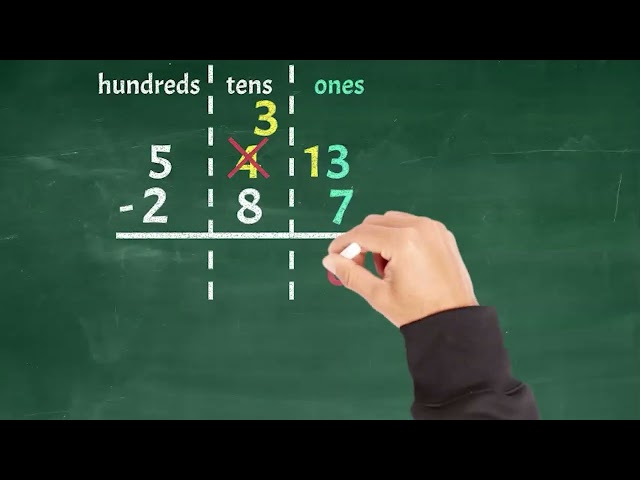
There are a variety of different charts and diagrams that can be used to teach 3 digit subtraction with regrouping. One common type of chart is a place value chart. A place value chart shows the value of each digit in a number, based on its position. This can help students to understand how to regroup numbers when they are subtracting.
Another type of diagram that can be used to teach 3 digit subtraction with regrouping is a number line. A number line shows the relationship between numbers, and it can help students to visualize the process of subtracting. For example, if a student is subtracting 23 from 56, they can use a number line to see that they need to move 23 spaces to the left. This will help them to understand that the answer is 33.
Using charts and diagrams to enhance the instructional process can provide several benefits for students. Visual aids can help students to:
- Understand complex concepts more easily.
- Develop problem-solving skills.
- Improve their memory and recall.
- Increase their engagement and motivation.
When creating charts and diagrams for 3 digit subtraction with regrouping, it is important to keep the following steps in mind:
- Start by explaining the concept of regrouping to students. Make sure they understand that when they subtract a number that is greater than the corresponding digit in the minuend, they need to regroup or “borrow” from the next place value.
- Create a chart or diagram that shows the steps involved in subtraction with regrouping. For example, you could use a place value chart to show how to subtract 23 from 56.
- Go through the steps of the subtraction problem with students, using the chart or diagram as a guide.
- Give students practice problems to solve on their own. Encourage them to use the chart or diagram to help them as needed.
By following these steps, you can create effective charts and diagrams that will help your students to master 3 digit subtraction with regrouping.
Essential Aspects of 3 Digit Subtraction with Regrouping Worksheets
Subtraction with regrouping is a fundamental mathematical operation that requires a solid understanding of place value and number relationships. Worksheets provide structured practice opportunities to reinforce this concept and develop fluency. Here are eight key aspects to consider when creating or using 3 digit subtraction with regrouping worksheets:
- Clear instructions: Worksheets should provide step-by-step instructions on how to perform subtraction with regrouping.
- Visual aids: Diagrams, number lines, or place value charts can help students visualize the regrouping process.
- Varied problems: Worksheets should include a range of problems to practice different scenarios and difficulty levels.
- Real-world examples: Incorporating real-world contexts can make subtraction more meaningful and engaging for students.
- Error analysis: Worksheets can include opportunities for students to identify and correct errors in their work.
- Independent practice: Worksheets should provide ample opportunities for students to practice subtraction with regrouping independently.
- Assessment: Worksheets can be used to assess student understanding and identify areas where additional support is needed.
- Differentiation: Worksheets can be differentiated to meet the needs of diverse learners, providing varying levels of support and challenge.
These key aspects work together to create effective 3 digit subtraction with regrouping worksheets that support student learning. By incorporating clear instructions, visual aids, varied problems, real-world examples, error analysis, independent practice, assessment, and differentiation, educators can help students develop a strong understanding of this important mathematical concept.
Clear instructions
In the context of “3 digit subtraction with regrouping worksheets,” clear instructions are paramount to ensure students’ successful comprehension and execution of the subtraction algorithm. Worksheets that lack clear and systematic guidance can lead to confusion and hinder student learning.
-
Facet 1: Explicit Steps
Effective worksheets break down the subtraction process into manageable steps. Each step should be clearly outlined, explaining the purpose and method involved. For example, the instructions might state: “Step 1: Subtract the ones digits. If the top number is smaller than the bottom number, regroup by borrowing 10 from the tens place.” By providing explicit steps, students can follow the algorithm systematically, reducing the likelihood of errors.
-
Facet 2: Visual Cues
In addition to written instructions, visual cues can enhance clarity. Diagrams or number lines can illustrate the regrouping process, making it easier for students to visualize the concept. For instance, a diagram might show how to “borrow” 10 from the tens place by crossing out the 10 and writing a small “9” above it.
-
Facet 3: Examples and Non-Examples
Providing worked-out examples can further clarify the instructions. These examples should demonstrate the subtraction process from start to finish, highlighting the application of each step. Non-examples can also be beneficial, showing students what not to do and common errors to avoid.
-
Facet 4: Error Prevention
Well-designed worksheets anticipate potential errors and provide guidance to prevent them. For instance, the instructions might emphasize the importance of regrouping when necessary and provide reminders to check if the top number is smaller than the bottom number.
By incorporating these facets of clear instructions, “3 digit subtraction with regrouping worksheets” empower students with a structured and comprehensible framework for solving subtraction problems accurately and efficiently.
Visual aids
Visual aids play a critical role in helping students understand and perform 3 digit subtraction with regrouping. Diagrams, number lines, and place value charts provide visual representations of the regrouping process, making it easier for students to grasp the concept and apply it accurately.
-
Facet 1: Diagrams
Diagrams can illustrate the steps of subtraction with regrouping in a clear and concise manner. For instance, a diagram might show how to subtract 23 from 56 by crossing out the 3 in 56 and writing a small “2” above it, then subtracting 2 from 5 to get 3 and writing it below. This visual representation helps students see how the numbers are regrouped and how the subtraction is performed.
-
Facet 2: Number lines
Number lines can also be used to visualize the regrouping process. For example, a number line can show how to subtract 23 from 56 by starting at 56 and moving 23 spaces to the left. This helps students understand that subtraction is a process of moving backward on the number line, and it also provides a visual representation of the regrouping that occurs when the top number is smaller than the bottom number.
-
Facet 3: Place value charts
Place value charts can help students understand the concept of place value and how it relates to regrouping. A place value chart can show the value of each digit in a number, based on its position. This helps students see how the numbers are regrouped when they are subtracting, and it also helps them to understand why regrouping is necessary.
By incorporating visual aids such as diagrams, number lines, and place value charts into “3 digit subtraction with regrouping worksheets,” educators can provide students with a variety of tools to support their learning. These visual representations can help students to visualize the regrouping process, understand the concept of place value, and apply subtraction algorithms accurately and efficiently.
Varied problems
In the context of “3 digit subtraction with regrouping worksheets,” varied problems play a pivotal role in developing students’ conceptual understanding and procedural fluency. Worksheets that incorporate a range of problems provide students with opportunities to practice different scenarios and difficulty levels, fostering their ability to apply subtraction algorithms accurately and efficiently.
The importance of varied problems stems from the fact that subtraction with regrouping involves multiple cognitive processes, including understanding place value, applying the regrouping algorithm, and managing mental computation. By exposing students to a variety of problems, worksheets can cater to diverse learning styles and ensure that students develop a comprehensive understanding of the concept.
For instance, a worksheet might include problems that require students to regroup from different place values (e.g., regrouping from the tens place or from the hundreds place). Additionally, problems can vary in difficulty, with some involving simple subtraction and others incorporating more complex scenarios, such as subtracting a 2-digit number from a 3-digit number or solving word problems that involve subtraction with regrouping.
Providing varied problems also helps students develop problem-solving skills and critical thinking abilities. By encountering different types of problems, students learn to analyze the problem structure, identify the appropriate strategies, and apply their knowledge of subtraction with regrouping to find solutions. This prepares them to tackle more challenging problems and apply their mathematical understanding in real-world contexts.
In conclusion, varied problems are an essential component of “3 digit subtraction with regrouping worksheets” as they promote a deeper understanding of the concept, enhance procedural fluency, and foster problem-solving skills. By incorporating a range of problems, worksheets provide students with the necessary practice and exposure to different scenarios, equipping them with the confidence and ability to succeed in subtraction with regrouping.
Real-world examples
In the context of “3 digit subtraction with regrouping worksheets,” real-world examples play a vital role in making subtraction more meaningful and engaging for students. By incorporating real-life scenarios and contexts into subtraction problems, worksheets can help students connect their mathematical learning to their everyday experiences, fostering a deeper understanding of the concept.
Real-world examples provide a tangible and relatable framework for students to apply their subtraction skills. For instance, a worksheet might include a problem about subtracting the cost of groceries from a weekly budget or calculating the remaining fabric after sewing a quilt. These types of problems help students see how subtraction is used in practical situations, making the learning process more relevant and motivating.
Moreover, real-world examples can help students develop problem-solving skills and critical thinking abilities. By encountering subtraction problems that are grounded in real-life contexts, students learn to analyze the problem structure, identify the relevant information, and apply their mathematical knowledge to find solutions. This prepares them to apply their subtraction skills to solve problems in a variety of settings, including future academic endeavors and everyday life.
In summary, incorporating real-world examples into “3 digit subtraction with regrouping worksheets” is essential for making subtraction more meaningful and engaging for students. By connecting subtraction to real-life scenarios, worksheets help students develop a deeper understanding of the concept, foster problem-solving skills, and prepare them to apply their mathematical knowledge in practical situations.
Error analysis
Error analysis is an essential component of “3 digit subtraction with regrouping worksheets” as it provides students with opportunities to identify, understand, and correct errors in their work. This process is crucial for developing students’ mathematical fluency and problem-solving skills.
When students encounter errors in their subtraction work, it is important to provide them with structured guidance to help them analyze the error and find the correct solution. Worksheets can incorporate various error analysis activities, such as:
- Identifying and correcting common errors, such as misalignment of numbers or incorrect regrouping.
- Analyzing error patterns to determine underlying misconceptions or misunderstandings.
- Providing students with opportunities to self-assess their work and identify areas for improvement.
By engaging in error analysis, students develop metacognitive skills, which involve reflecting on their own thinking and learning processes. This self-monitoring ability helps students become more independent learners and problem solvers, as they can identify and address their own errors without relying solely on teacher feedback.
Furthermore, error analysis can help students develop a deeper understanding of the subtraction algorithm and the underlying mathematical concepts. By examining their errors, students can gain insights into the relationships between place value, regrouping, and the subtraction process. This deeper understanding can lead to improved accuracy and efficiency in solving subtraction problems.
In summary, error analysis plays a vital role in “3 digit subtraction with regrouping worksheets” by providing students with opportunities to identify, understand, and correct errors. This process fosters students’ metacognitive skills, promotes a deeper understanding of subtraction concepts, and ultimately contributes to their mathematical growth and development.
Independent practice
Independent practice is a crucial component of “3 digit subtraction with regrouping worksheets” as it allows students to develop fluency and proficiency in applying the subtraction algorithm. Worksheets that incorporate ample opportunities for independent practice provide students with the necessary time and space to reinforce their understanding and master the skill.
Providing students with independent practice has several significant benefits. Firstly, it allows them to consolidate their learning and commit the subtraction process to long-term memory. By repeatedly practicing subtraction problems, students strengthen the connections between the concepts and procedures involved, making them more automatic and less prone to errors.
Secondly, independent practice fosters students’ self-reliance and problem-solving abilities. When students work through subtraction problems independently, they develop the confidence to tackle challenges without relying solely on teacher guidance. This self-reliance is essential for their mathematical development and future academic success.
Moreover, independent practice provides opportunities for students to identify and address their own errors. As they work through problems, they may encounter difficulties or make mistakes. By analyzing their errors and finding the correct solutions, students develop metacognitive skills and a deeper understanding of the subtraction process.
In summary, independent practice is a vital component of “3 digit subtraction with regrouping worksheets” as it allows students to reinforce their learning, develop self-reliance, and identify and address their own errors. By providing ample opportunities for independent practice, worksheets contribute to students’ mathematical growth and empower them to become confident and competent problem solvers.
Assessment
Assessment is an integral part of “3 digit subtraction with regrouping worksheets” as it enables educators to gauge students’ understanding of the subtraction algorithm and identify areas where additional support is necessary. Worksheets provide a structured and controlled environment for assessment, allowing teachers to evaluate students’ progress and tailor their instruction accordingly.
-
Diagnostic assessment
Worksheets can be used to conduct diagnostic assessments to determine students’ prior knowledge and identify any misconceptions or gaps in their understanding of subtraction with regrouping. By analyzing students’ responses, teachers can pinpoint specific areas where additional support is needed and provide targeted instruction to address those weaknesses.
-
Formative assessment
Worksheets can also be used for formative assessment purposes, providing ongoing feedback to students throughout the learning process. By incorporating practice problems and exercises, worksheets allow teachers to monitor students’ progress, identify areas where they need further practice, and make adjustments to their teaching strategies as needed.
-
Summative assessment
Worksheets can be used as summative assessments to evaluate students’ overall understanding of subtraction with regrouping at the end of a unit or lesson. Summative assessments provide teachers with a comprehensive view of students’ learning outcomes and can be used to assign grades or make placement decisions.
-
Error analysis
Worksheets can be used for error analysis to identify common mistakes that students make when performing subtraction with regrouping. By examining students’ work, teachers can determine the root causes of errors and develop targeted interventions to address those specific difficulties.
In summary, assessment plays a vital role in “3 digit subtraction with regrouping worksheets” by providing educators with valuable insights into students’ understanding and areas where additional support is needed. Through diagnostic, formative, summative, and error analysis assessments, worksheets empower teachers to tailor their instruction, monitor progress, and ensure that all students have the opportunity to succeed in mastering subtraction with regrouping.
Differentiation
In the context of “3 digit subtraction with regrouping worksheets,” differentiation plays a critical role in ensuring that all students have access to appropriate learning experiences that meet their individual needs. By providing varying levels of support and challenge, differentiated worksheets empower teachers to cater to diverse learning styles, readiness levels, and cognitive abilities.
-
Facet 1: Tiered Assignments
Tiered assignments involve creating multiple versions of worksheets with varying levels of difficulty. For instance, a basic tier might include simpler subtraction problems with smaller numbers, while an intermediate tier might introduce larger numbers and more complex scenarios, and an advanced tier might challenge students with multi-step problems or real-world applications. This allows students to work at their own pace and level, ensuring that they are neither overwhelmed nor underchallenged.
-
Facet 2: Visual Supports
Visual supports can be incorporated into worksheets to provide additional scaffolding for struggling learners. These supports might include visual representations of the regrouping process, such as diagrams or number lines. Additionally, color-coding or highlighting key steps can help students follow the algorithm more easily.
-
Facet 3: Guided Practice
Guided practice problems can be included in worksheets to provide step-by-step support for students who need more assistance. These problems might include worked-out examples or scaffolded questions that gradually release responsibility to the student. Guided practice helps students build confidence and develop strategies for solving subtraction problems independently.
-
Facet 4: Enrichment Activities
For students who have mastered the basic concepts, enrichment activities can be incorporated into worksheets to extend their learning. These activities might include challenging problems, puzzles, or investigations that require higher-order thinking skills. Enrichment activities help students deepen their understanding and develop their problem-solving abilities.
By incorporating differentiation into “3 digit subtraction with regrouping worksheets,” educators can create inclusive learning environments that meet the needs of all students. Tiered assignments, visual supports, guided practice, and enrichment activities empower teachers to provide varying levels of support and challenge, ensuring that each student has the opportunity to succeed and grow.
Subtraction with regrouping, also known as borrowing, is a fundamental mathematical operation that involves subtracting a smaller number from a larger number, even when the digits in the smaller number are greater than the corresponding digits in the larger number. In such cases, regrouping becomes necessary, where we “borrow” from the next place value to complete the subtraction.
“3 digit subtraction with regrouping worksheets” are educational resources designed to provide students with practice in performing subtraction with regrouping involving three-digit numbers. These worksheets typically include a series of subtraction problems that require students to apply the regrouping algorithm, reinforcing their understanding of the concept and developing their computational fluency.
The importance of “3 digit subtraction with regrouping worksheets” lies in their ability to:
- Enhance students’ understanding of place value and the concept of regrouping.
- Develop their computational skills and accuracy in performing subtraction with regrouping.
- Foster problem-solving abilities and critical thinking skills.
- Provide opportunities for students to identify and correct errors, promoting self-assessment and metacognitive skills.
In summary, “3 digit subtraction with regrouping worksheets” serve as valuable tools for educators to support students in mastering subtraction with regrouping, a crucial skill for mathematical proficiency and problem-solving in everyday life.
Frequently Asked Questions about “3 Digit Subtraction with Regrouping Worksheets”
This section addresses common questions and concerns related to “3 digit subtraction with regrouping worksheets” to provide clarity and enhance understanding.
Question 1: What is the purpose of “3 digit subtraction with regrouping worksheets”?
Answer: These worksheets provide students with practice opportunities to improve their understanding and computational skills in performing subtraction with regrouping involving three-digit numbers.
Question 2: Why is it important for students to learn subtraction with regrouping?
Answer: Subtraction with regrouping is a fundamental mathematical operation that strengthens students’ place value understanding and develops their problem-solving abilities.
Question 3: How can I use these worksheets effectively in my classroom?
Answer: “3 digit subtraction with regrouping worksheets” can be incorporated into lessons as guided practice, independent work, or assessment tools to reinforce concepts and monitor student progress.
Question 4: Are there any common errors that students make when subtracting with regrouping?
Answer: Some common errors include misalignment of numbers, incorrect regrouping, and computational mistakes. Worksheets can help students identify and address these errors.
Question 5: How can I differentiate these worksheets to meet the needs of diverse learners?
Answer: Worksheets can be differentiated by varying the difficulty of problems, providing visual supports, and offering tiered assignments to cater to different learning styles and abilities.
Question 6: Where can I find high-quality “3 digit subtraction with regrouping worksheets”?
Answer: Reputable educational websites, teacher resource repositories, and curriculum publishers often provide access to a range of these worksheets.
Summary: “3 digit subtraction with regrouping worksheets” are valuable resources for educators to support students’ understanding and proficiency in this mathematical operation. By incorporating these worksheets into their teaching practices, educators can enhance students’ problem-solving skills and foster a strong foundation for mathematical success.
Transition: For further insights into effective use of these worksheets, refer to the article section on best practices and strategies.
Conclusion on “3 Digit Subtraction with Regrouping Worksheets”
In summary, “3 digit subtraction with regrouping worksheets” are indispensable tools for educators to equip students with a solid understanding and proficiency in subtraction with regrouping. These worksheets provide ample opportunities for practice, reinforcing place value concepts and developing problem-solving abilities.
By incorporating these worksheets into instructional practices, educators can foster a deep understanding of mathematical operations and lay a strong foundation for students’ mathematical journey. As students become proficient in subtraction with regrouping, they gain confidence in their computational skills and develop a positive attitude towards mathematics.
Youtube Video: