Ottila Juliane Kron
Solar Eclipse Worksheet for Kids
A solar eclipse is a fascinating astronomical event that occurs when the Moon passes between the Sun and the Earth, blocking the Sun’s light. This can be a great opportunity to teach kids about the solar system, astronomy, and the wonders of the natural world. One way to do this is through the use of charts and diagrams.
Here are a few examples of charts and diagrams that you can use to create a solar eclipse worksheet for kids:
- Solar Eclipse Diagram: This diagram can show the positions of the Sun, Moon, and Earth during a solar eclipse. It can also label the different parts of the eclipse, such as the umbra and penumbra.
- Solar Eclipse Timeline: This chart can show the different stages of a solar eclipse, from the beginning to the end. It can also include information about the time and location of the eclipse.
- Solar Eclipse Safety Tips: This chart can provide kids with important safety tips for viewing a solar eclipse. It can include information about how to protect their eyes and how to avoid looking directly at the Sun.
Benefits of using charts and diagrams in a solar eclipse worksheet for kids:
- Visual aids: Charts and diagrams can help kids to visualize the concepts that you are teaching them. This can make it easier for them to understand the material.
- Engaging: Charts and diagrams can make learning more engaging for kids. They can help to break up the text and make the material more interesting.
- Reinforcement: Charts and diagrams can help kids to reinforce what they have learned. They can be used as a reference tool after the lesson.
Conclusion:
Charts and diagrams can be a valuable tool for teaching kids about solar eclipses. They can help to make the material more visual, engaging, and reinforcing. If you are planning a solar eclipse lesson, consider using charts and diagrams to help your kids learn about this fascinating astronomical event.
Essential Aspects of a Solar Eclipse Worksheet for Kids
A solar eclipse worksheet for kids should cover the essential aspects of this astronomical event in a clear and engaging way. Here are eight key aspects to consider when creating such a worksheet:
- Definition: What is a solar eclipse?
- Types: What are the different types of solar eclipses?
- Causes: What causes a solar eclipse?
- Safety: How can kids safely view a solar eclipse?
- Science: What are the scientific principles behind a solar eclipse?
- History: How have solar eclipses been viewed throughout history?
- Culture: What cultural significance do solar eclipses have?
- Activities: What activities can kids do to learn more about solar eclipses?
These aspects can be explored in more detail through examples, connections, and links to the main topic. For example, when discussing the causes of a solar eclipse, the worksheet could include a diagram showing the positions of the Sun, Moon, and Earth during an eclipse. When discussing the safety of viewing a solar eclipse, the worksheet could provide tips on how to make a solar viewer. And when discussing the cultural significance of solar eclipses, the worksheet could include information about how different cultures have interpreted and celebrated these events throughout history.
Definition
A solar eclipse is an astronomical event that occurs when the Moon passes between the Sun and the Earth, blocking the Sun’s light. This can be a fascinating sight to witness, and it can also be a great opportunity to teach kids about the solar system, astronomy, and the wonders of the natural world. A clear and concise definition of a solar eclipse is an essential component of a solar eclipse worksheet for kids, as it provides the foundation for understanding all other aspects of this astronomical event.
When creating a definition of a solar eclipse for a worksheet, it is important to use language that is clear and easy to understand for kids. For example, you could define a solar eclipse as “when the Moon gets in the way of the Sun’s light.” You could also include a diagram to help kids visualize what a solar eclipse looks like.
Once kids have a basic understanding of what a solar eclipse is, you can start to teach them about the different types of solar eclipses, the causes of solar eclipses, and the safety precautions that need to be taken when viewing a solar eclipse. By providing kids with a clear and comprehensive definition of a solar eclipse, you can help them to develop a strong foundation for understanding this fascinating astronomical event.
Types
There are three main types of solar eclipses: total, partial, and annular. A total solar eclipse occurs when the Moon completely blocks the Sun’s light. This can only happen during a new moon, when the Moon is positioned directly between the Sun and the Earth. A partial solar eclipse occurs when the Moon partially blocks the Sun’s light. This can happen during a new moon or a waning moon, when the Moon is not positioned directly between the Sun and the Earth. An annular solar eclipse occurs when the Moon passes directly in front of the Sun, but the Moon is not close enough to completely block the Sun’s light. This creates a “ring of fire” around the Moon.
-
Total Solar Eclipse:
During a total solar eclipse, the Moon completely blocks the Sun’s light. This can only happen during a new moon, when the Moon is positioned directly between the Sun and the Earth. Total solar eclipses are relatively rare, and they can only be seen from a narrow path on the Earth’s surface. However, they are one of the most awe-inspiring sights in nature.
-
Partial Solar Eclipse:
During a partial solar eclipse, the Moon partially blocks the Sun’s light. This can happen during a new moon or a waning moon, when the Moon is not positioned directly between the Sun and the Earth. Partial solar eclipses are more common than total solar eclipses, and they can be seen from a wider area on the Earth’s surface.
-
Annular Solar Eclipse:
During an annular solar eclipse, the Moon passes directly in front of the Sun, but the Moon is not close enough to completely block the Sun’s light. This creates a “ring of fire” around the Moon. Annular solar eclipses are less common than total solar eclipses, but they can be just as awe-inspiring.
It is important to note that it is never safe to look directly at the Sun during a solar eclipse. Even during a total solar eclipse, when the Moon is completely blocking the Sun’s light, the Sun’s corona is still visible. The corona is very bright, and it can damage your eyes if you look at it directly. Always use a solar filter or eclipse glasses to view a solar eclipse.
Causes
A solar eclipse is caused by the alignment of the Sun, Moon, and Earth. When the Moon passes between the Sun and the Earth, it blocks the Sun’s light. This can only happen during a new moon, when the Moon is positioned directly between the Sun and the Earth.
It is important to understand the causes of a solar eclipse in order to create an effective solar eclipse worksheet for kids. By explaining the causes of a solar eclipse in a clear and concise way, you can help kids to develop a strong foundation for understanding this astronomical event.
Here are some real-life examples that you can use to explain the causes of a solar eclipse to kids:
- Use a flashlight, a ball, and a small object to represent the Sun, Earth, and Moon. Show kids how the ball (Earth) blocks the light from the flashlight (Sun) when the small object (Moon) is placed between the flashlight and the ball.
- Take kids outside to observe the Moon during a new moon. Explain to kids that the Moon is not visible during a new moon because it is positioned directly between the Sun and the Earth.
- Show kids pictures or videos of solar eclipses. This can help kids to visualize what a solar eclipse looks like and to understand how it is caused.
By using real-life examples and clear explanations, you can help kids to understand the causes of a solar eclipse and to develop a strong foundation for learning about this astronomical event.
Safety
When creating a solar eclipse worksheet for kids, it is important to include information about how to safely view a solar eclipse. Looking directly at the Sun during a solar eclipse can damage your eyes, so it is important to take precautions. Here are some tips for safely viewing a solar eclipse:
- Use solar eclipse glasses. Solar eclipse glasses are specially designed glasses that block out harmful ultraviolet radiation from the Sun. They are the safest way to view a solar eclipse.
- Make a solar viewer. You can make a simple solar viewer using a cardboard box, aluminum foil, and a piece of white paper. Instructions for making a solar viewer can be found online or in books about solar eclipses.
- Project the image of the Sun onto a white surface. You can use a telescope or binoculars to project the image of the Sun onto a white surface, such as a piece of paper or a wall. This is a safe way to view a solar eclipse with a group of people.
- Do not look directly at the Sun. Even during a total solar eclipse, when the Moon is completely blocking the Sun’s light, it is still dangerous to look directly at the Sun. The Sun’s corona is still visible during a total solar eclipse, and it can damage your eyes if you look at it directly.
By including information about how to safely view a solar eclipse in your worksheet, you can help kids to enjoy this astronomical event safely and without damaging their eyes.
Science
To create an effective solar eclipse worksheet for kids, it is important to include information about the scientific principles behind a solar eclipse. Understanding the science behind a solar eclipse can help kids to develop a deeper appreciation for this astronomical event. Here are some of the key scientific principles that can be included in a solar eclipse worksheet for kids:
- The Earth, Moon, and Sun are all spherical objects. This means that they are all round, like a ball.
- The Moon orbits the Earth. This means that the Moon moves around the Earth in a circular path.
- The Earth orbits the Sun. This means that the Earth moves around the Sun in a circular path.
- A solar eclipse occurs when the Moon passes between the Earth and the Sun. This blocks the Sun’s light from reaching the Earth.
By including information about the scientific principles behind a solar eclipse in your worksheet, you can help kids to understand how this astronomical event occurs. This can help them to develop a deeper appreciation for the solar system and the wonders of the natural world.
Here are some real-life examples that you can use to explain the scientific principles behind a solar eclipse to kids:
- Use a ball, a smaller ball, and a flashlight to represent the Earth, Moon, and Sun. Show kids how the smaller ball (Moon) can block the light from the flashlight (Sun) when it is positioned between the flashlight and the ball (Earth).
- Take kids outside to observe the Moon during different phases of the moon. Explain to kids that the Moon’s phases are caused by the changing positions of the Moon, Earth, and Sun.
- Show kids pictures or videos of solar eclipses. This can help kids to visualize what a solar eclipse looks like and to understand how it is caused.
By using real-life examples and clear explanations, you can help kids to understand the scientific principles behind a solar eclipse and to develop a strong foundation for learning about this astronomical event.
History
Throughout history, solar eclipses have been viewed with a mix of awe, wonder, and fear. Some cultures have seen solar eclipses as a sign of bad luck or divine displeasure, while others have seen them as a time of renewal and rebirth. In many cultures, solar eclipses have been associated with important events, such as the birth or death of a king or the start of a new era.
-
Religious and Cultural Significance:
In many cultures, solar eclipses have been seen as a sign from the gods or a harbinger of important events. For example, the ancient Chinese believed that solar eclipses were caused by a dragon eating the Sun. In some Native American cultures, solar eclipses were seen as a time of great power and healing.
-
Scientific Observation:
In addition to their religious and cultural significance, solar eclipses have also been important for scientific observation. By studying solar eclipses, astronomers have been able to learn more about the Sun and its behavior. For example, the first accurate measurement of the Sun’s diameter was made during a solar eclipse in 1769.
-
Modern Understanding:
Today, we understand that solar eclipses are a natural astronomical event that occurs when the Moon passes between the Earth and the Sun. However, solar eclipses continue to fascinate people around the world. They are a reminder of the power of nature and the vastness of the universe.
Including information about the history of solar eclipses in a solar eclipse worksheet for kids can help them to understand the cultural and scientific significance of this astronomical event. It can also help them to appreciate the different ways that people have viewed and understood solar eclipses throughout history.
Culture
Solar eclipses have held cultural significance for many societies throughout history. In some cultures, they were seen as omens of good or bad luck, while in others they were seen as a time of spiritual renewal. By including information about the cultural significance of solar eclipses in a solar eclipse worksheet for kids, you can help them to understand the different ways that people have viewed and interpreted this astronomical event.
For example, you could include information about the following cultural beliefs and practices associated with solar eclipses:
- In ancient China, solar eclipses were seen as a sign of divine displeasure. People would often make loud noises and bang on pots and pans to scare away the dragon that was believed to be eating the Sun.
- In some Native American cultures, solar eclipses were seen as a time of great power and healing. People would often gather together to pray and meditate during solar eclipses.
- In India, solar eclipses are seen as a time of inauspiciousness. People often avoid doing important tasks during solar eclipses, such as getting married or starting a new business.
Including information about the cultural significance of solar eclipses in a solar eclipse worksheet for kids can help them to develop a deeper understanding of this astronomical event. It can also help them to appreciate the different ways that people have viewed and interpreted solar eclipses throughout history.
Activities
Activities can play a crucial role in enhancing kids’ understanding of solar eclipses beyond just theoretical knowledge. By engaging in hands-on experiences, children can reinforce their learning, develop critical thinking skills, and cultivate a deeper fascination for astronomy.
-
Interactive Experiments:
Involving kids in simple experiments can make learning about solar eclipses more tangible. For instance, using a flashlight, a ball, and a smaller ball to simulate the Sun, Earth, and Moon can help them visualize the mechanics of an eclipse. Such hands-on activities foster a practical understanding of the concepts.
-
Observation and Recording:
Encouraging kids to observe solar eclipses safely, either directly or through indirect methods like pinhole projectors, can be a valuable learning experience. By recording their observations through drawings, notes, or photography, they develop observational skills and learn to document scientific phenomena.
-
Creative Projects:
Art projects related to solar eclipses can stimulate kids’ creativity while reinforcing their knowledge. Activities like making eclipse viewers, designing eclipse-themed posters, or writing stories about solar eclipses encourage them to express their understanding in unique ways.
-
Research and Presentations:
Assigning kids research projects on solar eclipses fosters their inquiry skills and deepens their understanding. Having them present their findings to the class promotes their communication abilities and allows them to share their knowledge with peers.
Incorporating these activities into a solar eclipse worksheet for kids can transform learning from a passive process to an active and engaging experience. By actively participating in these activities, kids can develop a more comprehensive understanding of solar eclipses and cultivate a lifelong interest in astronomy.
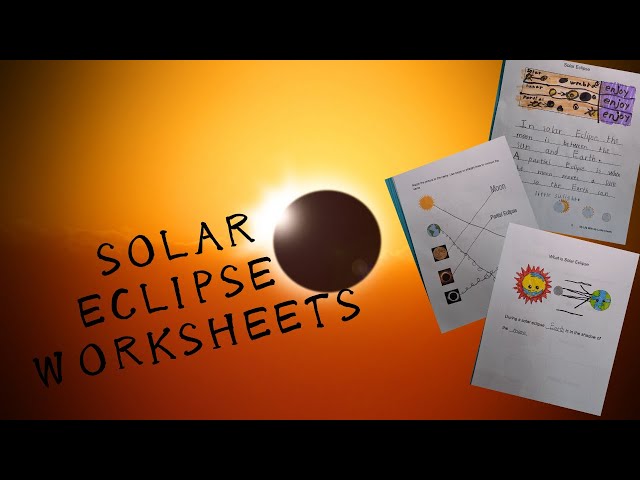
A solar eclipse worksheet for kids is an educational resource designed to introduce children to the astronomical phenomenon of solar eclipses. It provides an engaging and interactive way for young learners to explore the causes, types, and significance of solar eclipses. Solar eclipse worksheets often include diagrams, illustrations, and activities to make learning about this celestial event accessible and enjoyable.
Incorporating solar eclipse worksheets into science lessons offers numerous benefits. They help children develop a foundational understanding of astronomy, fostering curiosity and inspiring a lifelong interest in space exploration. Moreover, these worksheets enhance critical thinking skills, problem-solving abilities, and scientific inquiry. By engaging in hands-on activities and experiments, children learn to observe, analyze, and draw conclusions, essential skills for scientific literacy.
Solar eclipse worksheets also provide an opportunity to delve into the historical and cultural significance of solar eclipses. Throughout history, various cultures have held different beliefs and practices associated with solar eclipses, reflecting the profound impact of celestial events on human civilization.
FAQs on Solar Eclipse Worksheets for Kids
Solar eclipse worksheets for kids are a valuable educational tool, providing an engaging and accessible way to teach children about this astronomical phenomenon. Here are some frequently asked questions and answers to help you understand and utilize these worksheets effectively:
Question 1: What is the purpose of a solar eclipse worksheet for kids?
Solar eclipse worksheets aim to introduce kids to the concept of solar eclipses, explaining their causes, types, and significance. They provide a structured and interactive approach to learning about this celestial event, fostering curiosity and scientific inquiry.
Question 2: What are the benefits of using solar eclipse worksheets in the classroom?
Solar eclipse worksheets offer several benefits, including:
- Enhanced understanding of astronomy and celestial phenomena.
- Development of critical thinking, problem-solving, and scientific inquiry skills.
- Exploration of the historical and cultural significance of solar eclipses.
- Increased engagement and interest in science and space exploration.
Question 3: What should I look for when choosing a solar eclipse worksheet for kids?
When selecting a solar eclipse worksheet, consider the following factors:
- Age appropriateness and difficulty level.
- Clarity and accuracy of the information provided.
- Variety of activities and experiments to engage learners.
- Alignment with educational standards and curriculum objectives.
Question 4: How can I use solar eclipse worksheets in my lessons?
Solar eclipse worksheets can be incorporated into lessons in various ways:
- As an introduction to the topic, sparking curiosity and interest.
- As a reinforcement tool, reviewing and solidifying concepts learned.
- As an assessment tool, evaluating students’ understanding and retention.
- As a supplement to hands-on activities and experiments.
Question 5: Where can I find high-quality solar eclipse worksheets for kids?
reputable educational websites and organizations provide free and downloadable solar eclipse worksheets. Additionally, teachers can create their own worksheets tailored to their specific teaching needs and student learning objectives.
Question 6: Are solar eclipse worksheets suitable for homeschooling?
Yes, solar eclipse worksheets are an excellent resource for homeschooling. They provide a structured and engaging way for children to learn about solar eclipses at their own pace and in the comfort of their homes.
In summary, solar eclipse worksheets for kids are a valuable educational tool that can enhance students’ understanding of this fascinating astronomical phenomenon. By carefully selecting and effectively utilizing these worksheets, educators can foster a love of science, critical thinking, and exploration in young learners.
Transitioning to the Next Article Section:…
Conclusion
In summary, solar eclipse worksheets for kids provide an engaging and effective way to introduce children to the fascinating world of astronomy. Through interactive activities, experiments, and informative content, these worksheets foster a deep understanding of solar eclipses, their causes, types, and significance.
By incorporating solar eclipse worksheets into the classroom or homeschooling environment, we can inspire young learners to develop a lifelong passion for science, critical thinking, and the exploration of the cosmos. These worksheets not only impart knowledge but also cultivate essential skills that will benefit children in their academic and personal endeavors.
Youtube Video: